Plinko Casino Australia 2026: What to Know Before You Play
 Available in US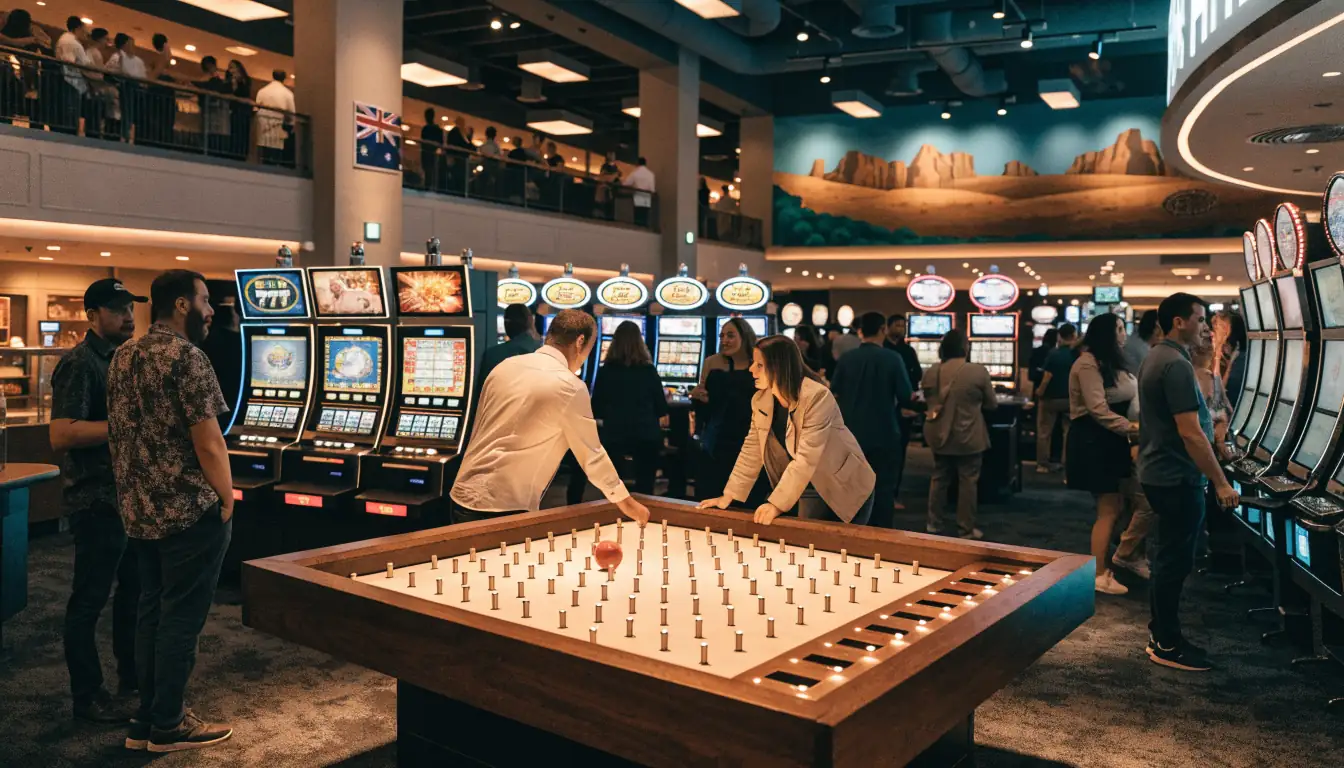
Table of Contents
- Understanding Slot Machines and Their Role in Australian Gaming
- The Rise of Online Casinos in Australia
- Playing Plinko for Real Money: What You Need to Know
- Game Types and Variations Available in Australian Casinos
- Australian Casino Landscape: Size and Economic Impact
- How to Evaluate a Plinko Casino Review
- What Is Plinko Casino? Definitions and Core Features
- Free Play and Demo Options for Plinko Games
- Cryptocurrency and Plinko: Current Landscape
- Lucky Guru and Similar Brands: A Brief Overview
Understanding Slot Machines and Their Role in Australian Gaming
Pokies are everywhere in Australia. Walk into a pub, a club, or a licensed venue in almost any suburb and you’ll find rows of them, lit up and waiting. That local name — pokies — is worth understanding before anything else, because it covers a specific category of machine gambling that sits at the centre of how Australians actually gamble, both in venues and, increasingly, online.
A slot machine, in its physical form, is a cabinet that accepts a wager and spins a set of reels or displays a randomised outcome, paying out according to a fixed set of rules programmed into it. There’s no skill involved and no interaction with another player or a dealer. You press a button, the outcome resolves, and the machine moves to the next round. That simplicity is exactly why pokies have become the dominant form of gambling machine in Australian venues — they require no explanation, no strategy, and no wait.
The scale of this is not a matter of impression. Australians placed bets worth almost AUD$150 billion through electronic gaming machines in the 2020–2021 financial year. Of that turnover, players lost a combined AUD$12 billion — the difference between what went in and what came back out. Divided across the population, that works out to a per-capita loss of AUD$608 for that year alone. These aren’t marginal figures; they describe a form of gambling that a very large share of the adult population has some direct or indirect contact with, whether through their own play or through venues in their community.
Before you spin the plinko boards for real money, it pays to check how a casino handles bonuses, deposits and payouts — the details below give you a quick sense of what to expect from each site.
Bonus: up to A$7,500 + 550 free spins across 10 deposits, 50x wagering · Payout speed: crypto under 1 hour, PayID 1-3 business days · Min. deposit: A$20 (A$30 to qualify for the bonus) You get a sizeable multi-deposit bonus package with a large batch of free spins spread across ten deposits, backed by fast crypto withdrawals and quick PayID processing for a low minimum deposit.
License: Curacao Gaming Control Board OGL/2023/176/0095 (Hollycorn N.V.) · Bonus: up to A$11,000 + 300 free spins (code NEO100) Licensed under Curacao’s Gaming Control Board via Hollycorn N.V., this operator pairs that regulatory backing with a substantial welcome bonus and free spins unlocked via a bonus code.
Bonus: up to A$750 + 50 jackpot spins, 35x wagering · Payout speed: crypto ~90 minutes, fiat 1-5 days · Min. deposit: A$30 You’ll find a solid welcome bonus that includes jackpot spins with reasonable wagering terms, plus fast crypto payouts and a modest minimum deposit for getting started.
License: Curacao, operated by Dama N.V. · Bonus: 325% up to 5.25 BTC + 250 free spins across 4 deposits Operated by Dama N.V. under a Curacao license, this casino stands out for a crypto-focused welcome offer with a high percentage match and free spins spread across several deposits.
License: Curacao Gaming Control Board · Bonus: up to A$5,000 + 400 free spins Holding a Curacao Gaming Control Board license, this site offers a generous welcome bonus combined with a large number of free spins for new players.
Bonus: 100% up to A$750 + 200 free spins, 35x wagering · Payout speed: crypto 30-120 minutes, fiat 24-72 hours · Min. deposit: A$30 You get a welcome bonus with free spins and manageable wagering requirements, plus quick crypto payouts and fast fiat processing for a low minimum deposit.
License: Curacao Gaming Control Board OGL/2023/176/0095 (Hollycorn N.V.) · Bonus: 100% up to A$10,000 + 100 free spins Licensed through Curacao’s Gaming Control Board under Hollycorn N.V., this operator offers a full-match welcome bonus with a high ceiling plus free spins for new players.
License: Curacao – Antillephone N.V. (Versus Odds B.V.) · Bonus: up to EUR 2,000 across 5 deposits + 200 free spins · Min. deposit: EUR 20 Backed by a Curacao license via Antillephone N.V. and operated by Versus Odds B.V., you get a multi-deposit welcome package with free spins and an accessible minimum deposit.
License: Curacao · Bonus: 100% up to A$500 + 200 free spins, 10x wagering · Payout speed: crypto 30-60 minutes, fiat 1-5 days · Min. deposit: A$10 You benefit from a welcome bonus with free spins and notably low wagering requirements, plus fast crypto payouts and a very low minimum deposit to get going.
License: Curacao OGL/2024/1335/0780 · Bonus: up to A$1,000 + 150 free spins, wager-free · Min. deposit: EUR 20 Licensed in Curacao, this casino offers a wager-free welcome bonus with free spins, making it straightforward to understand what you’re getting from the start.
Why Pokies Are So Widespread
Part of the answer is regulatory and historical: poker machines have been permitted in licensed pubs and clubs across most Australian states for decades, in a way that isn’t replicated at this scale anywhere else in the world relative to population size. Venues have an obvious commercial incentive to install them — a pokies floor generates steady revenue with comparatively low staffing and floor-space overhead compared with table games. That incentive, multiplied across tens of thousands of venues, is why the machine count in some regions is so dense that it becomes a talking point in its own right, discussed later in this piece when the article turns to the size of the market in specific terms.
How the Machines Actually Work
Whether it’s a physical cabinet in a club or a game running on a phone screen, the mechanism behind the outcome is the same in principle: a random number generator, or RNG. This is a piece of software (or, in older physical machines, a mechanical equivalent) that produces an unpredictable result each time you play, independent of anything that happened on the previous spin. There’s no such thing as a machine being "due" for a win, and no pattern to detect, because each outcome is generated fresh.
Online, this matters more than it might seem. Online casino games use RNGs to ensure random outcomes, and reputable platforms have that RNG software regularly audited by independent testing agencies — third parties whose job is to confirm that the random number generation is actually random and hasn’t been skewed in the operator’s favour. This is one of the few areas where a game’s fairness can be verified independently rather than taken on trust, and it’s a detail worth knowing regardless of which specific slot or pokie you’re looking at.
Slots as a Category, Not a Single Game
It helps to think of "slots" as a category rather than one type of game. Under that umbrella sit an enormous range of titles, themes, and mechanical variations — from simple three-reel formats that mimic the classic pub machine to elaborate multi-reel video slots with bonus rounds layered on top. What unites them is the underlying mechanic: a wager, a randomised outcome, and a payout structure defined by the game’s rules. Online, this entire category is often referred to as online pokies, a direct extension of the venue-based terminology into the digital space, and it’s a dominant category on most Australian online casino sites — usually the largest single section of any given platform’s game library, ahead of card games, table games, or anything else on offer.
A broad category of games with many themes, paylines and bonus features.
Australian term for slot machines, dominant in pubs and clubs.
A single‑mechanic drop game, distinct from slot reels.
This is also where slots start to diverge clearly from something like Plinko, which this article covers in detail in later sections. Plinko is a single mechanic — a disc dropped through a field of pegs, landing in one of several outcome slots — rather than a broad category with thousands of themed variations. Slots, by contrast, are a genre. There isn’t one "slot machine" any more than there’s one "song"; there are countless individual games that share a common structural logic but differ enormously in presentation, pace, and payout design.
Demo Play and What It Actually Shows You
Many slot games can be played in demo mode, using virtual funds rather than real money. This matters for anyone trying to understand a machine before wagering on it, because a demo mode lets you see how a specific title behaves — how often it triggers bonus features, how the pacing feels, whether the theme and presentation suit you — without financial risk attached. It’s not a substitute for understanding the legal position of real-money play in Australia, which is addressed separately later in this article, but it is a legitimate way to become familiar with how the RNG-based mechanics of a given slot title actually play out over a session, since no amount of reading about a game substitutes for watching its outcomes unfold.
Slots Versus the Rest of the Casino Floor
Understanding slots properly also means understanding what they are not. They are not table games, which involve a defined set of rules shared across every implementation — blackjack is blackjack, wherever you play it, with variations at the margins. They are not card games in the traditional sense, where structure and, in some formats, an element of decision-making shape the outcome. And they are not games like Plinko, where the appeal lies in a single, visually simple mechanic rather than thematic variety. Slots occupy their own space precisely because there are so many of them, because each one is self-contained, and because the RNG sits behind every single spin regardless of the artwork or soundtrack wrapped around it.
This distinction matters for anyone trying to make sense of an Australian casino’s game library, whether in a physical venue or online. A venue’s pokies floor and an online casino’s slots section serve the same basic function — high-volume, low-friction machine gambling — even though the delivery mechanism and regulatory position differ substantially between the two, a difference this article addresses directly in the sections that follow on the legal status of online play in Australia.
What This Means Going Into the Rest of This Guide
Slots, and their local cousin the pokie, form the backdrop against which everything else in Australian gambling gets measured — including a comparatively simple, mechanically distinct game like Plinko. Where a slot title might offer dozens of paylines, bonus rounds, and thematic variations, Plinko strips the format down to a single drop and a single outcome. That contrast is worth keeping in mind as this guide moves from the machine-dominated world of pokies into the specifics of Plinko, real-money play, and the legal framework that governs all of it in Australia.
The Rise of Online Casinos in Australia
Search interest in terms like plinko online casino or online casino plinko real money reflects a broader shift that has been building for years: gambling moved from the pub floor to the phone screen. That shift did not happen because the law changed to allow it. It happened despite the law staying largely the same.
Illegal Offering
Offering real‑money Plinko to Australian residents breaches the Interactive Gambling Act 2001.
The technical side is straightforward enough. Platforms built for online play now run on the same kind of infrastructure that powers streaming and mobile banking, which is part of why a plinko live casino format — a ball drop game with a live host and real-time video — can run smoothly on a phone connection that would have struggled a decade ago. According to one industry overview of the sector, the number of online casino sites, including operators marketing to Australians, has been increasing, driven by the same wave of technological integration seen in online gambling markets globally. That is a statement about the industry’s general trajectory, not a claim about any specific operator’s size or standing — and it should be read that way.
RNG games and live-dealer games
Whatever the branding — golden plinko casino, plinko pokies, or any other label attached to a ball-drop game — the mechanics behind an online plinko casino game fall into one of two categories:
- RNG-based games — outcomes are generated by software (a Random Number Generator) rather than a physical mechanism. A digital plinko board, digital roulette wheel, or digital card shuffle all fall here.
- Live-dealer games — streamed in real time with a professional dealer or host running the game, giving the format an in-person feel despite being played on a screen.

A plinko casino online product can exist as either version, or both, depending on how the operator has built it. The live version tends to draw players who want to watch the ball drop happen rather than trust an unseen algorithm; the RNG version is generally faster and available at any hour without needing a host on shift.
The regulatory environment behind the growth
Here is where the story gets more complicated than most product pages let on. In Australia, the growth of online casino platforms has not happened with the backing of a domestic licensing system — because no such system exists for casino-style games. The Australian Communications and Media Authority (ACMA) is the regulator responsible for enforcement in this space, but its role is not to license or approve online casinos the way it licenses broadcasters. There is no local approval process to point to, and no "Australian-licensed online casino" that legally offers plinko, roulette, or slots to residents of this country.
What has grown, instead, is the number of offshore-licensed sites accessible to Australian players and marketing toward searches for online plinko casino, online casino with plinko, and similar terms. These operators hold licences from regulators in other jurisdictions — Malta and the UK are common examples — not from any Australian authority, because no Australian authority issues them.
This matters for anyone trying to make sense of what "regulation" means on a page like this one. Two conditions apply regardless of where an operator is licensed:
- Age: the minimum age to play at any online casino operator serving the Australian market is 18.
- Residency: players are expected to be Australian residents to participate, which operators typically verify during account setup or before withdrawal.
Neither of these requirements comes from an Australian casino licence, because there isn’t one to attach them to. They are baseline conditions the operators themselves apply, largely because offshore regulators and payment providers require it, not because a domestic regulator is checking compliance on this specific point.
What "growth" looks like from the player’s side
For someone searching what online casino has plinko or comparing options under a plinko casino game online search, the practical effect of this growth is more choice, not more oversight. More sites means more versions of the same game, more marketing language, and more bonus offers attached to sign-up — and bonus terms are where the fine print tends to matter most. Bonuses at these platforms typically carry wagering requirements, restrictions on which games count toward clearing them, and expiry dates after which unused bonus funds or winnings can be forfeited. None of that is unique to plinko; it is standard practice across the online casino category, and it is worth reading before assuming a bonus is worth claiming.
Bonus Risks
Bonus offers often carry wagering requirements and expiry dates that can trap your funds.
The technology has genuinely improved: live-dealer streams run with less lag, RNG outcomes are processed instantly, and mobile versions of these games are no longer an afterthought bolted onto a desktop site. What has not changed is the legal position of the market these platforms operate in when it comes to Australian players — a point the next section addresses directly, since it shapes what "playing for real money" actually means here in practice, not just in theory.
Playing Plinko for Real Money: What You Need to Know
Plinko looks simple enough: a disc drops through a field of pins and lands in a slot with a payout multiplier attached. Playing it for real money, though, means stepping into a legal grey area that Australian players deserve to understand clearly before any funds change hands.
The legal position, stated plainly
Two versions of the same law are cited across different sources: the Interactive Gambling Act 2001 and, in some references, the Interactive Gambling Act 1997. The discrepancy exists in publicly available material itself, and this article won’t pretend to resolve it by picking one. What’s consistent across both versions is the substance: online casino-style games — including slots, poker, blackjack, roulette, and by extension Plinko — are prohibited under the Interactive Gambling Act 2001. That prohibition, along with the ban on online casino, poker, and in-play betting, is federal, meaning it applies regardless of which state or territory you’re in.

Critically, the law targets the operator, not the player. It is not illegal for an individual Australian to play at an offshore-licensed online casino offering Plinko for real money. What’s illegal is offering that service to Australian residents in the first place — which is why no domestically licensed real-money online casino operators exist for Australian players. Any site offering Plinko for cash to an Australian audience is doing so under a licence issued somewhere else, not under any Australian authorisation, because no such authorisation is available to obtain.
This matters practically. When a platform advertises itself as "licensed" without naming a local authority, that’s not an oversight to shrug off — it’s a signal that the licence, whatever it is, was issued by a regulator with no jurisdiction over Australian consumer protection.
What "real money" actually involves
Playing Plinko with real funds means three things happen outside the drop of the disc itself:
- Deposits go through a payment processor tied to the operator’s offshore licence, not an Australian bank product designed for gambling.
- Winnings are subject to the platform’s own withdrawal rules — verification steps, processing windows, and any restrictions the operator sets, none of which are standardised or enforced by an Australian body.
- Disputes have no local regulator to escalate to. Whatever complaint process exists is whatever the offshore operator provides.
None of this is illegal for the player to engage in. It does mean the safety net that exists for licensed domestic activities — sports betting and lotteries, for instance, which are properly licensed at state and territory level — simply doesn’t extend to real-money Plinko.
Withdrawal processes: what to expect and what to check
Because no Australian regulator oversees these platforms, withdrawal terms vary entirely by operator, and there’s no official body publishing standard rules for how long a withdrawal should take or what proof is required. Anyone playing Plinko for real money should read the operator’s own terms directly rather than relying on general assumptions about how online gambling withdrawals work elsewhere. Where an operator doesn’t publish clear withdrawal terms at all, that absence is itself useful information.
How this differs from free play and crypto
Free-play and demo versions of Plinko sit outside this real-money framework entirely — no funds move, so no payment or withdrawal question arises, and no offshore-operator relationship is created. That distinction is covered in more detail elsewhere in this guide.
Deposits, withdrawals and dispute handling are governed solely by the offshore operator’s terms, not by any Australian regulator.
Cryptocurrency deposits for Plinko occupy a separate lane again. Paying with Bitcoin or Ethereum doesn’t change the underlying legal status of the game — it changes only the payment rail. The legal considerations around who’s permitted to offer the game to Australians remain the same whether the currency is AUD or crypto.
The scale of gambling in Australia, for context
Australia’s relationship with gambling machines is already outsized: the country holds 3% of the world’s pub and club poker machines while accounting for just 0.3% of the global population. That imbalance is a land-based statistic, not an online one, but it’s worth keeping in mind when weighing how normalised gambling access already is here — and how little that normalisation has to do with whether real-money online Plinko is being offered lawfully.
If you choose to play Plinko for real money, the practical takeaway isn’t a warning to avoid it — it’s a reminder to treat every claim on an offshore platform, from licensing to withdrawal times, as something to verify yourself rather than something guaranteed by an Australian authority standing behind it.

Game Types and Variations Available in Australian Casinos
Plinko sits inside a much wider catalogue of game types, and where it lands in that catalogue matters for anyone trying to understand what a plinko casino game actually is next to the rest of the offering.
Card games
Poker, baccarat, and blackjack make up the core of the card category, and each is offered in many variations rather than a single fixed ruleset. That variety is the point: a card game builds around decisions made against other players or against the house, hand by hand, with rules that change from one variant to the next. A plinko game casino title works nothing like this. There are no hands, no betting rounds against an opponent, and no strategic choices once the ball is dropped. The comparison matters because Plinko is sometimes lumped in with "table classics" in marketing copy, when structurally it has almost nothing in common with them.
Games like poker and blackjack that involve hand‑based decisions.
Games such as roulette and craps using wheels or dice.
A drop‑and‑peg game with a single outcome per round.
Table games
The table category covers roulette, craps, Pai Gow, and Sic Bo. These games share a physical or simulated apparatus — a wheel, dice, tiles — and odds that are fixed by the rules of that apparatus. Craps and Sic Bo, in particular, involve dice outcomes that a player can read and reason about before betting. Plinko’s board looks like it belongs in this family, since it also has a physical-style layout with a ball and pegs, but the mechanism underneath is different: outcomes in an online plinko casino game are generated electronically, not by tracking a physical roll or spin. Visually it resembles a table game; functionally it behaves closer to the slot side of the catalogue, which is covered in detail elsewhere in this guide.
Where Plinko actually fits
Treating Plinko as its own category, separate from cards and table games, is the more accurate way to look at the wider list of casino games plinko sits alongside. It doesn’t use cards, it doesn’t use dice, and it doesn’t involve other players. The ball drop produces a single outcome per round, closer in pace and structure to a slot spin than to a hand of blackjack or a round of craps, even though nothing about its board resembles a reel.
Demo access across categories
Card and table titles are frequently available in a free-play mode alongside their real-money versions, letting a player see the rules and pacing of a specific variant before wagering anything. This mirrors what’s available for slots and, separately, for Plinko itself — a topic addressed later in this guide rather than here, since the mechanics of Plinko’s demo mode differ enough from card and table demos to warrant its own explanation.

A regional reminder
The scale of Australia’s physical gaming floor is worth keeping in view while comparing digital categories. New South Wales alone accounts for roughly 95,800 pokies, and the Central Coast region contributes 4,672 of those machines — about 2.37% of the national total. Gosford, within that region, has around 1,928 machines, close to one for every 71 adults living there. None of that infrastructure runs card or table games in the sense described above; it’s almost entirely pokies, which is a separate discussion from the card, table, and Plinko-style products examined in this section.
Australian Casino Landscape: Size and Economic Impact
The physical scale of gambling infrastructure in Australia is easiest to see at the local level, where pokies sit in pubs and clubs at a density that few other countries match. In Wyong, on the New South Wales Central Coast, there are roughly 2,608 poker machines for the local adult population — about one machine for every 47 adults. That ratio is worth sitting with for a moment: it means a machine is never far from anyone who walks into a licensed venue in the area, regardless of whether they came in looking for one.
This density matters when you try to place Plinko, and casino-style gaming generally, into the wider Australian market. Land-based pokies are licensed, regulated at the state and territory level, and physically counted — which is why figures like Wyong’s exist at all. Online casino games, including Plinko, sit in a different category entirely: no domestic licence covers them, so there’s no equivalent official count of how many Australians play them, how much is staked, or where the money goes. Any claim about the size of the online casino market in Australia — Plinko included — is necessarily an estimate from operators or third-party reviewers, not a regulated figure.
RNG
Random Number Generator – software that produces unpredictable results for each game spin or drop.
Sports betting is the exception. Online sports and racing wagering is legal under state and territory licensing schemes, which means it produces the kind of auditable numbers that pokies do — venue counts, machine density, licensing records. Online casino games don’t have that paper trail in Australia, because the activity itself isn’t licensed here.
For a game like Plinko, this creates an odd asymmetry. The physical, regulated gambling economy — pokies in clubs, licensed sports betting — is well documented down to the suburb. The online, unregulated side, where Plinko and similar games actually live, is not. Reviews and marketing material will sometimes present growth figures or player numbers for online casino gaming as though they carry the same weight as the Wyong pokie count. They don’t. One is a licensed activity with public records; the other is an offshore product operating outside any Australian licensing regime, and its true scale simply isn’t published anywhere a reader can verify.
How to Evaluate a Plinko Casino Review
Search results for Plinko reviews range from detailed breakdowns to thin pages built around a name and a screenshot. Knowing what separates the two matters more than reading a fifth opinion on the same title.
A useful review states who wrote it and what they checked, rather than repeating marketing copy about excitement or big wins. It should mention whether the writer actually tested the game, name the software provider where relevant, and describe how the drop mechanic and payout structure actually work rather than describing Plinko in generic terms that could apply to any game.
Watch for reviews that promise guaranteed outcomes or describe gambling as a way to make money. That framing is a warning sign regardless of how polished the page looks.
For Australian readers specifically, a review worth trusting will not tell you to "check the operator’s licence" as though a local one exists, because no domestic licensing framework covers online casino games, Plinko included. A review that skips this distinction, or implies otherwise, has skipped the one legal fact that actually applies to the market it’s writing for.
What a substantive review should cover
- Mechanics: how the drop and multiplier zones function, described specifically rather than vaguely
- Provider identification: which studio built the version being reviewed
- Fund handling: how deposits, withdrawals, and identity verification are described
- Bonus terms: whether wagering requirements and expiry conditions are disclosed upfront, not buried
- Responsible-gambling content: whether self-exclusion and support resources appear at all
A review missing most of these isn’t a review — it’s an advertisement wearing a review’s structure.
What Is Plinko Casino? Definitions and Core Features
Plinko casino refers to a digital adaptation of the drop-and-peg game popularised by television, rebuilt as a betting product for online play. A disc or ball is released from the top of a pegged board, bounces unpredictably as it falls, and lands in one of several slots at the bottom, each tied to a different payout. Unlike a physical Plinko board, the outcome online is decided by a Random Number Generator (RNG) rather than actual gravity and collision physics, even though the visual bounce is animated to look mechanical.
This places Plinko in a category of its own rather than alongside pokies or table games. There’s no reel, no card deck, and no dealer — just a single falling object and a payout grid. The player’s only decision is usually the size of the stake and sometimes the risk level, which changes how the payout slots are weighted; everything after that is automated by the RNG.
That simplicity is part of what distinguishes Plinko from slot machines discussed elsewhere in this guide, and from the card and table games covered separately. There’s no bonus round structure, no paylines, and no live-dealer element. Each drop is a single, quick event, which is why Plinko is often grouped with other instant-outcome games rather than with slots or live casino products.

Because the mechanics are so minimal, most of what differentiates one Plinko casino product from another comes down to the platform offering it — its interface, stake limits, and how it structures risk settings — rather than the underlying game logic itself, which stays largely the same wherever it appears.
Free Play and Demo Options for Plinko Games
Demo mode runs Plinko on virtual credits instead of cash, which is why it sits outside the legal grey zone that covers real-money play. No deposit, no withdrawal, no identity check — the ball drops, the multipliers land, and nothing changes hands. That makes it the only version of Plinko that offshore platforms can show to an Australian visitor without immediately raising the question of whether they should be serving that visitor at all.
The mechanics in demo mode are identical to the paid version: a board of pegs, a dropped token, and a payout table tied to where it lands. What differs is the outcome — a win or loss with no financial consequence attached. This is useful for understanding how the game behaves before deciding whether to move further, though it says nothing about withdrawal speed, verification steps, or the legal standing of the operator running it, which are separate questions covered elsewhere in this guide.
Free play also has a ceiling. Some sites gate the demo behind a sign-up, others cap session length, and none of them publish consistent rules about it — there’s no regulator tracking demo-mode terms, so claims about "unlimited" free spins should be read as marketing rather than fact.
Cryptocurrency and Plinko: Current Landscape
Bitcoin and Ethereum sit alongside cards, e-wallets, and bank transfers on many offshore platforms that host Plinko, and some sites market themselves specifically around crypto deposits and withdrawals. None of this changes the legal picture described elsewhere in this piece: the Interactive Gambling Act 2001 prohibits offering these games to Australian residents regardless of which currency moves the stake.
There is a separate wrinkle specific to crypto. The restriction against accepting credit cards or digital currencies for deposits and betting is a compliance rule aimed at licensed operators — and there are no domestically licensed real-money online casino operators in Australia to begin with. Offshore sites accepting Bitcoin or Ethereum for Plinko are operating entirely outside that framework, not inside it with an exemption.
For a player, that means crypto doesn’t buy legal cover. It changes how funds move, not whether the operator is licensed, regulated, or accountable to anyone in Australia. Whatever protections a regulator might otherwise enforce simply don’t apply here.
Lucky Guru and Similar Brands: A Brief Overview
Names like Lucky Guru turn up regularly in searches for Plinko, often alongside review aggregators that use "guru" or "casino guru" branding to signal expertise. These sites typically function as directories or comparison hubs rather than operators themselves — they list providers, summarise terms, and link onward to where the games are actually played.
That distinction matters. A brand built around Plinko content isn’t the same as a licensed gambling operator, and none of these naming conventions imply any Australian licensing status, because no such domestic licence for online casino games exists.
For Australian readers, the practical difference between Lucky Guru and any other similarly branded site is mostly cosmetic: presentation, layout, which providers get featured first. What doesn’t change is the underlying legal position — the platforms these brands point to are offshore-licensed, and their availability to Australian players sits within the same framework covered elsewhere in this piece, not outside it.
What is the minimum legal gambling age in Australia?
You must be at least 18 years old to play at online casino operators in Australia.
Are online casino games legal for Australian residents to play?
It is not illegal for you to play at offshore-licensed online casinos, as the Interactive Gambling Act 2001 targets operators, not players. However, there are no domestically licensed real-money online casino operators available.
How do online slot machines determine their outcomes?
They use Random Number Generators (RNGs) to produce an unpredictable result for each spin. Reputable platforms have this software regularly audited by independent testing agencies to confirm the outcomes are fair and genuinely random.
Can I try online slots before wagering real money?
Yes, many slot games offer a demo mode using virtual funds. This allows you to see how a specific title behaves, including how often it triggers bonus features, without any financial risk.
How are online casinos in Australia regulated?
Online casino regulation in Australia is overseen by the Australian Communications and Media Authority (ACMA), with the Interactive Gambling Act 2001 serving as the primary Commonwealth law governing online gambling.
Created by the ”Casino Jackpots Guide” editorial team.