
Best Casinos for Online Craps in Australia
Australian gambling regulation and what it means for online craps
Australia does not have a single gambling law or a single regulator that decides what you can and cannot play. Regulation runs on two levels at once — federal and state/territory — and they don’t always ask the same question. That split matters more for craps than for almost any other casino game, because craps has never really existed as a licensed product on this market. To understand why, it helps to look at how the two levels actually divide the work.
The federal layer: the Interactive Gambling Act
At the Commonwealth level, the relevant law is the Interactive Gambling Act 2001 (IGA), introduced with a stated focus on harm minimisation rather than on maximising tax revenue or industry growth. It’s the law that decides what an operator is allowed to offer an Australian resident online, regardless of which state that resident lives in.
There’s a wrinkle here worth naming rather than smoothing over: some sources date the prohibition on offering online casino games to Australian residents to 1997, while the Act itself is more commonly cited as the Interactive Gambling Act 2001. The two references don’t fully agree on the year, and rather than pick one silently, it’s worth flagging that the record itself is inconsistent — what’s not in dispute is the substance of the rule.
Before you sit down at a virtual craps table, it pays to check how a casino handles bonuses, deposits and payouts, since these details shape your real experience once the dice start rolling. Here’s a closer look at what stands out about each option.
Bonus: up to A$7,500 + 550 free spins across 10 deposits, 50x wagering · Payout speed: crypto under 1 hour, PayID 1-3 business days · Min. deposit: A$20 (A$30 to qualify for the bonus) Offers a large multi-deposit bonus package with free spins spread across ten deposits, backed by fast crypto withdrawals and quick PayID processing for Australian players.
License: Curacao Gaming Control Board OGL/2023/176/0095 (Hollycorn N.V.) · Bonus: up to A$11,000 + 300 free spins (code NEO100) Licensed under the Curacao Gaming Control Board and backed by Hollycorn N.V., this operator pairs its licensing credentials with a sizeable welcome bonus plus free spins available via a bonus code.
Bonus: up to A$750 + 50 jackpot spins, 35x wagering · Payout speed: crypto ~90 minutes, fiat 1-5 days · Min. deposit: A$30 Provides a welcome bonus with bonus jackpot spins and reasonable wagering terms, plus fast crypto payouts and a low minimum deposit to get started.
License: Curacao, operated by Dama N.V. · Bonus: 325% up to 5.25 BTC + 250 free spins across 4 deposits Operated by Dama N.V. under a Curacao license, it stands out for a substantial crypto-denominated welcome bonus spread over multiple deposits with a generous free spins allocation.
License: Curacao Gaming Control Board · Bonus: up to A$5,000 + 400 free spins Holds a Curacao Gaming Control Board license and offers a solid welcome bonus with a healthy number of free spins for new players.
Bonus: 100% up to A$750 + 200 free spins, 35x wagering · Payout speed: crypto 30-120 minutes, fiat 24-72 hours · Min. deposit: A$30 Combines a welcome bonus with free spins and moderate wagering requirements, plus fast crypto and fiat payout speeds and an accessible minimum deposit.
License: Curacao Gaming Control Board OGL/2023/176/0095 (Hollycorn N.V.) · Bonus: 100% up to A$10,000 + 100 free spins Backed by a Curacao Gaming Control Board license through Hollycorn N.V., it offers one of the larger welcome bonus amounts on this list along with free spins.
License: Curacao – Antillephone N.V. (Versus Odds B.V.) · Bonus: up to EUR 2,000 across 5 deposits + 200 free spins · Min. deposit: EUR 20 Licensed via Antillephone N.V. in Curacao, it spreads its bonus across several deposits with free spins included, catering to players comfortable with a low minimum deposit.
License: Curacao · Bonus: 100% up to A$500 + 200 free spins, 10x wagering · Payout speed: crypto 30-60 minutes, fiat 1-5 days · Min. deposit: A$10 Features a Curacao license and a welcome bonus with notably low wagering requirements, plus fast crypto payouts and one of the lowest minimum deposits around.
License: Curacao OGL/2024/1335/0780 · Bonus: up to A$1,000 + 150 free spins, wager-free · Min. deposit: EUR 20 Holds a Curacao license and stands out for offering a wager-free bonus structure alongside free spins, making it approachable for bonus-focused players.
And the substance is blunt. Online casino-style games — slots, poker, blackjack, roulette, and by extension electronic or live-dealer craps — are prohibited under the IGA. Not "restricted," not "taxed differently": prohibited. The Act targets the supply side. It’s illegal for a company to offer online casino gambling to people in Australia, and there’s no licensing pathway that lets an operator obtain a domestic real-money online casino licence. That’s not a gap regulators are planning to fix — it’s a deliberate design choice. As things stand, there are no domestically licensed real-money online casino operators available to Australian players, and that includes any operator advertising online craps tables.
What the IGA does not do is criminalise the player. The law is written to catch the business offering the game, not the individual placing a bet. It is not illegal for an Australian to play at an offshore-licensed online casino. That asymmetry — illegal to offer, not illegal to use — is the single most important thing to understand before reading anything else about craps in this market, because it explains why offshore sites keep advertising to Australians even though no Australian regulator has approved them.
Who actually enforces this
The Australian Communications and Media Authority (ACMA) is the federal body responsible for enforcing the IGA. Its main enforcement tool isn’t prosecuting overseas operators directly — jurisdiction makes that difficult — but ordering Australian internet service providers to block access to sites it identifies as illegal offshore gambling services. That blocking regime has been running since November 2019.
The scale of it has been reported differently by different sources, and the numbers have moved over time as enforcement has continued. One account, current as of a 2024 publication, put the blocked-site count at 975 illegal gambling and affiliate websites since the scheme began. A later figure, cited as of August 2025, puts the total at 1,296 blocked sites and affiliates, alongside roughly 220 services that are reported to have withdrawn from the Australian market voluntarily rather than face enforcement. A separate account, from a single industry source, states that more than 100 illegal gambling services exited the market following ACMA’s enforcement push that began in 2017. These aren’t the same claim restated three ways — they’re different snapshots from different points in an ongoing process, and none of them should be read as a fixed, current total. What they agree on is the direction: the list of blocked and departed operators has been growing, not shrinking.
Two practical points follow from this. First, a site being reachable from an Australian internet connection today is not evidence that it’s sanctioned, safe, or even that it will still be reachable next month — ISP-level blocking is an ongoing, moving process, not a one-time cleanup. Second, none of this enforcement activity has produced a domestic online casino licence of any kind. Blocking offshore sites and licensing local ones are two different projects, and only the first one has actually happened.
The ACMA block list is constantly changing – a site that is reachable today may be blocked tomorrow, so accessibility does not guarantee safety or continued access.
The state and territory layer
Above and alongside the federal rules sits a patchwork of state and territory regulation, and this is where the "no single overarching authority" point becomes concrete rather than abstract. Each Australian state and territory runs its own gambling regulator, with its own remit, and none of them has authority that simply overrides the others.
A few of these are worth naming because they come up often in discussions of Australian gambling generally, even though — as covered below — none of them licenses online casino games:
- The Northern Territory Racing Commission (NTRC) functions, in practice, as the country’s de facto hub for online wagering licensing. It’s not that the NTRC was handed special federal authority — it’s that its tax arrangement made it the preferred base for national online bookmakers, so a large share of Australia’s licensed online betting activity is technically domiciled there.
- The Victorian Gambling and Casino Control Commission (VGCCC) monitors wagering service providers for compliance with the National Consumer Protection Framework — and notably, this oversight isn’t limited to Victorian-based operators. It extends to providers based in other states as well, which is one of the few points where state regulation reaches beyond its own borders.
- Liquor & Gaming NSW, like the VGCCC, regulates gambling activity within its own state framework.
Land-based casinos — venues like Crown Melbourne, the Southern Hemisphere’s largest casino, which does operate physical table games under Victorian oversight — answer to state government regulators and law enforcement, a completely separate regulatory track from the federal rules that govern anything happening online. A poker table or a craps pit inside a licensed Australian casino building sits under state gaming law. A craps game streamed to your phone from an offshore server sits, at least in theory, under the federal IGA — except that the IGA prohibits exactly that offer, which is precisely why no legitimate local operator provides it.
This layered structure has one significant practical consequence for anyone looking specifically for craps: state and territory regulators, including VGCCC and Liquor & Gaming NSW, have limited power over offshore online casinos. Their authority runs to licensees operating within their own borders — retail wagering shops, local casino floors, state-licensed lottery products. It does not extend to a gambling site incorporated in another country and accessed over the internet. That enforcement gap is filled, imperfectly, by the federal ACMA blocking regime described above — not by any state body.
What this actually means if you’re looking for online craps
Put the two layers together and the picture for craps specifically is clear, even if it isn’t the picture most players expect.
Craps, wherever it’s offered as a real-money online casino game — live-dealer stream, electronic terminal, or otherwise — falls squarely inside the category of "online casino style games" the IGA prohibits operators from offering to Australian residents. It sits in the same regulatory bucket as online roulette, online blackjack, and online poker. There is no separate carve-out for dice games, and no domestic licence that would let an Australian-based operator run a legal online craps table for real money. If you’re standing in Crown Melbourne’s gaming floor and playing craps at a physical table, you’re in a state-regulated, legal environment. If you’re looking for the same game on a phone or laptop, the operator offering it to you is doing so from outside the reach of any Australian gambling licence, because no such licence exists to be granted in the first place.
Playing on an offshore site is not illegal for an Australian resident; the Interactive Gambling Act targets the operator, not the individual player.
That doesn’t make it illegal for you, personally, to play. The IGA’s enforcement logic targets the business, not the punter, and nothing in Australian law criminalises an individual for placing a bet with an offshore site. What it does mean is that the usual reassurances you’d look for elsewhere — a local licence number, a domestic regulator to complain to, a public register to check an operator against — simply don’t apply here, because there is no domestic real-money online casino licence to check for and no public register of approved operators to search. Any site claiming Australian government approval for its online craps tables is making a claim that has no basis in how this market is actually structured.
What legitimacy does exist for offshore operators comes from wherever they happen to be licensed — a state and territory framework, if it’s genuinely an Australian-facing sports betting product; or a foreign regulator, if it’s an offshore casino site. Neither of those licences is granted by, or answerable to, an Australian body. ACMA can order ISPs to block a site it judges illegal; it can’t compel a foreign regulator to revoke that operator’s licence in its home jurisdiction, and it doesn’t maintain a whitelist of offshore sites it considers acceptable. The blocking list is a record of what’s been identified as breaching the IGA, not a filter that leaves only "safe" sites reachable.
The gap between land-based rules and online reality
It’s worth being explicit about why this two-track system exists, rather than treating it as an oversight. Land-based casinos in Australia went through state licensing processes precisely so that states could regulate venues physically located, staffed, and taxed within their own borders — inspect the tables, license the operators, collect the revenue, enforce responsible-gambling rules on-site. That model doesn’t transfer to the internet. A state regulator can’t meaningfully license or inspect a server sitting in another country, and the federal government chose, through the IGA, to close that gap not by building a national online casino licensing scheme but by prohibiting the offer altogether and leaving enforcement to site-blocking.
The result is a market where a game like craps has a fully legal, state-regulated home on a casino floor, and no legal, licensed home online at all. That’s not a loophole waiting to be closed one way or the other — it’s the deliberate shape of the current framework, and it’s been stable for long enough that nothing in current enforcement trends suggests a domestic online casino licensing scheme is coming.
What to actually take from this before reading further
None of the above is a reason to assume every offshore craps site is comparable, or that the absence of Australian licensing means the absence of any oversight whatsoever — operators may hold licences from regulators such as the Malta Gaming Authority or the UK Gambling Commission, bodies that exist and enforce standards, just not standards that Australian law recognises as sufficient to make the offer to Australian residents legal. What the regulatory picture does mean is narrower and more useful than a blanket verdict: there is no Australian licence to look for, no Australian regulator to appeal to if something goes wrong with a real-money craps game, and no public Australian register that could confirm or deny an operator’s standing. Whatever due diligence is possible has to be done by looking at the foreign licence actually claimed, not by hunting for a local one that can’t exist.
No Australian licence
There is no domestic licence for online craps in Australia, meaning you cannot appeal to any Australian regulator if something goes wrong.
That distinction — legal for you to play, illegal for anyone to offer domestically, no domestic register to check — is the frame the next sections build on when they get into the actual formats craps takes online and what the numbers around it look like in practice.
Craps casino games: live tables, virtual versions and where to find them
Craps looks intimidating from the outside — the table is covered in betting boxes, and the crowd around a physical table tends to shout at moments that seem to come from nowhere. Once you know what you’re looking at, though, the game splits into a small number of formats, and each one plays quite differently on a screen than it does at a rail.
The physical table
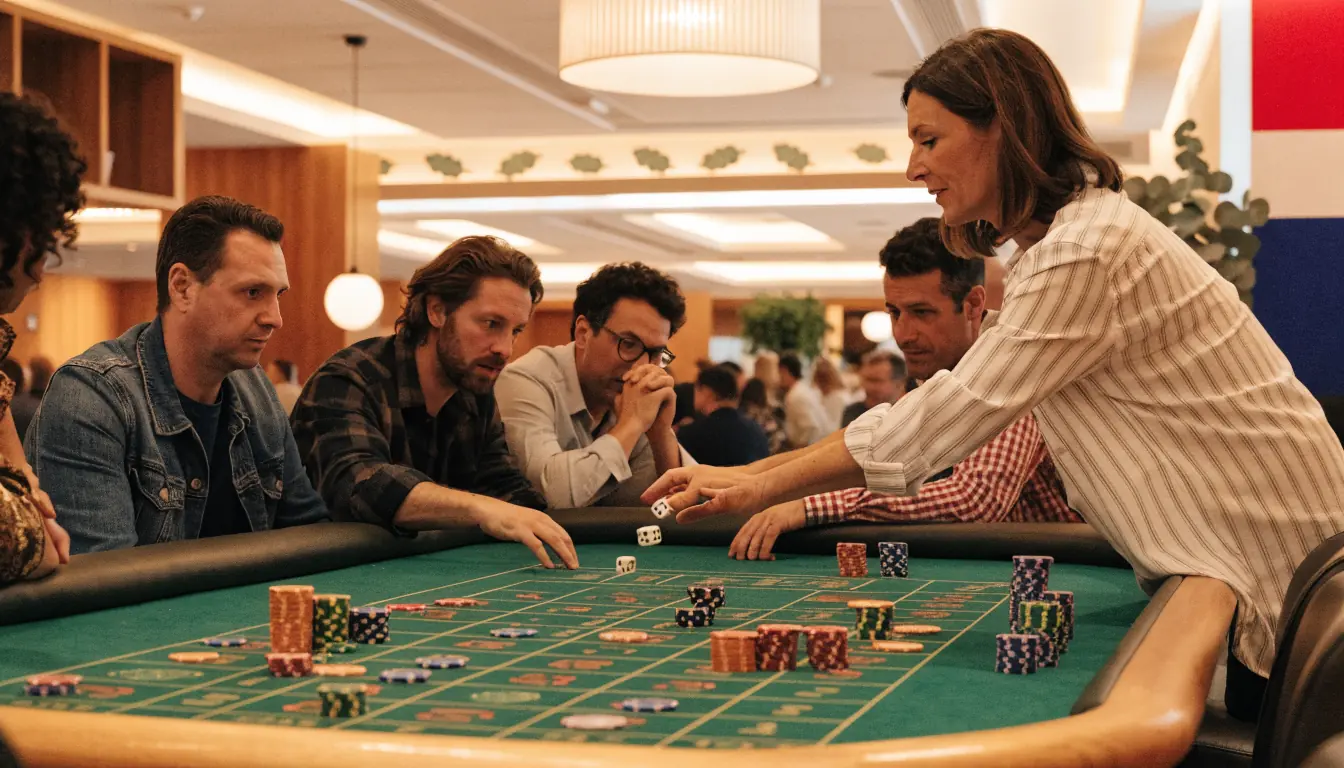
The version most people picture is the one at a brick-and-mortar casino: a sunken table with padded rails, a stickman moving the dice with a curved stick, a boxman watching the chips, and one or two dealers paying and collecting bets on either side. Crown Melbourne, the largest casino in the Southern Hemisphere, runs tables of this kind, and the format is broadly the same wherever it’s offered — players take turns as the shooter, the dice have to hit the back wall of the table to count, and bets go down before the come-out roll.

What’s worth knowing before you go: a live craps table moves fast, involves a lot of side bets you don’t need to make, and rewards watching a few rounds before putting money down. Dealers expect you to place chips yourself rather than hand them across the layout, and the stickman calls the point and the numbers loudly enough that you can follow the action even from the back of a crowd. None of this transfers directly to how the game is offered online, which is where things get more complicated for an Australian player.
Why the online picture is split in two
Craps offered over the internet falls into two categories that look similar on a lobby page but sit on opposite sides of the law as it applies in Australia.
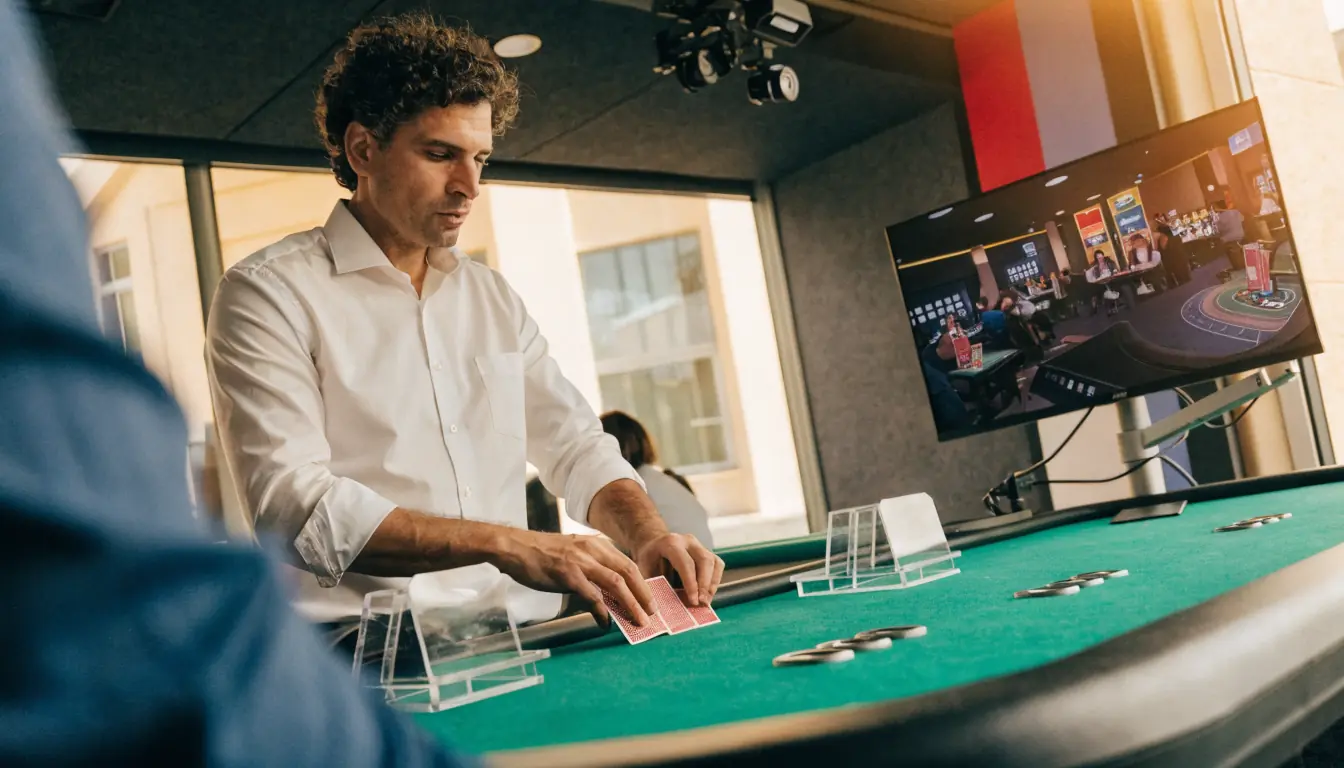
The first is live-dealer craps — a real table, filmed and streamed, with a human dealer running the game in real time while players place bets through a screen. This is functionally an online casino game: a table game played for real money, streamed to a device, operated by whoever runs the platform. The Interactive Gambling Act 2001 prohibits providing this kind of online casino game to Australian residents, and no domestically licensed operator offers it. Streamed craps exists on some offshore-licensed sites, and playing there as an individual isn’t illegal under Australian law — the Act targets the businesses offering the game, not the person placing the bet — but there’s no local licence backing any of it, and no Australian regulator overseeing how the stream is run, how disputes get resolved, or whether the dice mechanism behind the camera is what it claims to be.
Real dice are filmed and streamed; the experience mimics a physical table but is prohibited for Australian residents.
Outcomes are generated by software; instant results and no camera, also prohibited for Australian residents.
Played in‑person at a land‑based casino under state regulation; fully legal and regulated.
The second category is the virtual or RNG-based version — no camera, no dealer, just a random number generator producing dice outcomes behind the scenes. RNG stands for Random Number Generator, the software that decides each roll instead of physical dice. These virtual tables are built to mimic the visual layout of a craps table — the same betting boxes, the same come-out roll sequence — but the underlying mechanism is closer to a slot machine than to a casino floor. They fall under the same restriction as live-dealer versions: an online casino table game, prohibited for Australian residents under the same Act, regardless of whether a person or a piece of software is generating the outcome.
A third format sometimes marketed alongside craps is the crash-style game — a fast, continuously running product where a multiplier climbs and the player decides when to cash out, dressed up with dice or craps-style graphics but structurally unrelated to the actual game. These are worth naming because they show up in the same lobbies and get grouped under "craps" in marketing copy, even though the mechanic underneath has nothing to do with a come-out roll or a point number. Whatever the branding, the same legal frame applies to any table or dice-based game offered for real money to someone in Australia: it’s not permitted, and there’s no local licence to check because none exists.
What the difference feels like in practice
| Format | How it’s run | What it resembles most | Australian legal position |
|---|---|---|---|
| Physical table | Real dice, live dealers, in-person crowd | A land-based table game | Regulated by state/territory casino licensing, not the IGA |
| Live-dealer streamed | Real dice or a real wheel-style mechanism, filmed and streamed | An online casino table game | Prohibited for AU residents to be offered; not illegal for a player to access offshore |
| Virtual/RNG craps | Software-generated outcomes, no camera | A slot machine with craps graphics | Same prohibition as above |
| Crash-style “dice” games | Continuously running multiplier, dice imagery only | An arcade/instant-win game | Falls under the same online casino restriction if real money is involved |
The physical table sits in a different regulatory lane altogether — it’s licensed and supervised the way any land-based casino floor is, under state and territory rules rather than the federal Interactive Gambling Act. Everything below it in the table is an online offering, and the law doesn’t distinguish between a streamed human dealer and a random number generator: both are online casino games, and both are off-limits for anyone operating them toward Australian residents.
What playing each version actually involves
Live-dealer craps, where it’s technically accessible through an offshore platform, tries to replicate the social pace of a real table: a stickman-equivalent narrates the roll, other players’ bets appear on the same virtual layout, and there’s a lag between placing a bet and seeing the dice land that a physical table doesn’t have. The appeal is watching a real roll rather than trusting an algorithm, but that appeal comes with the caveats already covered — no domestic licence, no Australian regulator with power over the operator, and customer support that isn’t available around the clock, so a dispute during off-hours can sit unresolved for a stretch.
Interactive Gambling Act (IGA)
Australia’s federal law that prohibits operators from offering online casino‑style games, including live‑dealer and virtual craps, to Australian residents.
Virtual craps strips away the wait. Bets go down, a button triggers the roll, and the outcome resolves instantly. There’s no shooter, no crowd, no stickman calling numbers — just the betting grid and a result. Some virtual versions let a player set the software to roll repeatedly without manual input for a set run rather than pressing a button every time, similar to the autoplay features found on slot machines. That convenience is also the biggest difference in player experience: a physical table forces pauses between rolls while chips get placed and collected, and a screen doesn’t.
Crash-style dice games remove the craps structure entirely. There’s no point number, no pass line, no come bets — just a rising multiplier and a decision about timing. Anyone searching for craps and landing on one of these should know they’re looking at a different game wearing similar artwork.
Where these formats actually show up
For an Australian reader, "where to find them" has an uncomfortable answer: legally, live-dealer and virtual craps for real money aren’t offered by any Australian-licensed operator, because no such licence exists to begin with. What does exist locally is the physical table at land-based casinos like Crown Melbourne, regulated the way any casino floor is regulated by its state government.

Offshore platforms — the kind licensed by regulators such as the Malta Gaming Authority or the UK Gambling Commission rather than by anything Australian — do list both live-dealer and virtual craps, and Australian residents accessing them individually aren’t breaking the law by doing so. But it’s worth being precise about what that means in practice: those sites operate outside the reach of Australian regulators, which have no power to intervene if something goes wrong with a payout, a dispute, or the fairness of the game itself. The Australian Communications and Media Authority can order internet service providers to block a site’s domain, and it has been doing so for offshore gambling services since November 2019, but blocking access to a URL doesn’t extend consumer protection to whatever happens before the block takes effect.
Live versus virtual: the actual trade-offs
Framed as a straight comparison, the two online formats trade off against each other in a fairly predictable way.

Live-dealer craps offers:
- A real dealer and real dice, filmed rather than simulated
- A slower pace closer to a physical table
- Visible other players and bets on the same table
Virtual/RNG craps offers:
- Instant resolution with no wait between rolls
- The option to automate repeated rolls rather than pressing a button each time
- A game that’s structurally simpler to audit, precisely because there’s no camera or human dealer to account for — though auditing only matters where a regulator exists to demand it, and for an Australian player using an offshore site, that regulator sits in another country, if it exists at all
Neither format changes the legal position. Both are online casino games under the Interactive Gambling Act’s definition, both are unavailable through any Australian-licensed operator, and the only version with a genuine domestic legal footing is the physical table on a land-based casino floor.
Legal landscape
Online craps is prohibited for Australian operators, legal for players, and has no local licensing framework.
A note on how the game gets marketed
It’s common to see craps bundled into "table games" sections of a casino lobby alongside blackjack and roulette, sometimes with strategy guides attached that promise a system for beating the house edge. Treat those the way you’d treat any gambling strategy claim: the pass line and come bets in craps have a fixed structure regardless of what a guide calls a "system," and no staking pattern changes the underlying odds of the dice. Resources like Craps for Dummies are useful for learning the betting layout and the names of the bets — don’t-pass, field, hardways — without pretending any of it tilts the math in the player’s favour.
The next section looks at what actually determines the financial side of playing craps for real money online — return-to-player figures, stake ranges, and what they mean in practice — while the section after that walks through the mechanics of a physical table for anyone planning to play in person rather than through a screen.
Real‑money electronic craps: RTP, stakes and payout considerations
Electronic and bubble craps run on a random number generator rather than a physical table, which changes what "the house edge" actually means for a player putting down real money. The RTP quoted for a given machine reflects the manufacturer’s own testing of that specific game, not a fixed rule that applies to craps as a category. One equipment maker, Ainsworth, publishes an RTP of 94% for its version — a figure worth noting precisely because it comes from that single provider’s own specification sheet, not from an independent audit of the craps market as a whole. A different cabinet, a different studio, or a live-dealer stream built by another provider can sit well away from that number, and there is no publicly available benchmark that tells you what "typical" looks like across electronic craps generally.

This matters for how you read a payout table before staking anything. Electronic craps machines display their odds and payout structure on-screen or in a printed reference card, and that in-machine disclosure is the only reliable figure for the unit you’re actually playing — not a percentage you saw quoted for a different make elsewhere.
Stakes on electronic and bubble craps are set by the machine or platform itself rather than negotiated at a table, which suits players who want to control exposure precisely rather than match a live shooter’s bets. Because craps carries genuine payout risk and is played for real money where it’s offered, the same underlying principle applies as with any casino wagering: gambling here is a legalised activity, not a novelty side game, and it should be treated with the same caution around bankroll and stake size as any other real-money bet. Checking the specific machine’s disclosed odds before playing remains the only way to know what you’re actually facing.

How to play craps at a casino – a quick step‑by‑step guide
Craps at a physical casino, such as Crown Melbourne, follows a fixed sequence that’s easy to pick up by watching a round before betting.
- Buy in at the table. Hand cash to the dealer, not the stickman, and wait for coloured chips.
- Wait for the come-out roll. This first roll of a new round sets the point number (unless it’s a 7 or 11, which ends it immediately).
- Place a Pass Line bet. This is the simplest bet: you win if the shooter rolls a 7 or 11 on the come-out, lose on 2, 3 or 12, and otherwise wait for the point to repeat.
- Let the shooter roll again. Once a point is set, the shooter keeps rolling until that number reappears (a win for Pass Line bets) or a 7 comes up (a loss).
- Follow table etiquette. Keep one hand off the table while rolling, don’t touch chips mid-round, and let the stickman handle the dice between throws.
This layout applies specifically to land-based tables; the earlier sections cover how live and virtual craps differ online.
What are the best online casinos in Australia for 2026?
There are no domestically licensed real-money online casino operators available to Australian players, as offering online casino games is prohibited under the Interactive Gambling Act 2001. You can legally play at offshore-licensed casinos, but no Australian regulator has approved them.
How safe are my funds at a crypto casino?
The safety of your funds depends entirely on the specific offshore operator you choose, since no domestic Australian licensing pathway exists for online casinos. You must verify the operator’s reputation and licensing status independently, as you have no local regulatory protection.
How can I verify if a gambling operator is legal?
Online sports betting operators are legal if they hold a state or territory licence, with most national bookmakers licensed by the Northern Territory Racing Commission. Online casinos, however, cannot obtain a domestic licence, so any casino site advertising to you is operating offshore without Australian regulatory approval.
How can I manage deposits and withdrawals responsibly?
You should manage your deposits and withdrawals carefully, because the Interactive Gambling Act 2001 was introduced with a deliberate focus on harm minimisation. Since you are playing at offshore casinos without domestic regulatory protection, setting strict personal deposit limits before you start is essential.