
Best Casino Apps in Australia: What Actually Works
 Available in US
Table of Contents
- Understanding Australian Casino Apps Landscape
- How Mobile Browsers Deliver Online Casino Experiences
- Casino Access on iPhone: What You Need to Know
- Top Android Casino Apps and Their Requirements
- Real‑Money Play on Australian Casino Apps
- Welcome Bonuses, Free Spins and No‑Deposit Offers
- Free Casino Apps and Zero‑Cost Features
- iOS and iPad Optimised Casino Browsers
- Payment Options that Actually Pay Out
- Gambling Regulations and Fair Play in Australia
Understanding Australian Casino Apps Landscape
Search for the best casino apps in Australia in 2026 and you won’t find them in an app store the way you might expect. Offshore operators serving Australian players don’t distribute through Google Play or the App Store as gambling apps in the conventional sense, since local rules and platform policies around gambling software make that path narrow. What fills the gap is the mobile web app: a site built with HTML5 that runs inside your phone’s browser and behaves like an installed program without ever going through a store listing or an install prompt.
This is why most popular casino apps used by Australians aren’t apps you download at all. You open a browser, load the site, and everything — the lobby, the games, your account, the cashier — runs there. There’s no separate binary sitting on your phone, no update to approve, no storage taken up beyond what the browser caches. For anyone coming from app-store habits, this takes a moment to adjust to, but it’s the dominant model here and it isn’t changing anytime soon.
The split between platforms matters. Android is the only platform in Australia where native casino apps exist in any officially sanctioned form, distributed under specific licensing terms. iPhone users don’t get that option. Apple’s store policies keep real-money casino apps out entirely, so anyone on an iPhone accesses these platforms exclusively through the mobile browser. That’s not a workaround or a lesser version of the experience — for iOS, it’s the only version.
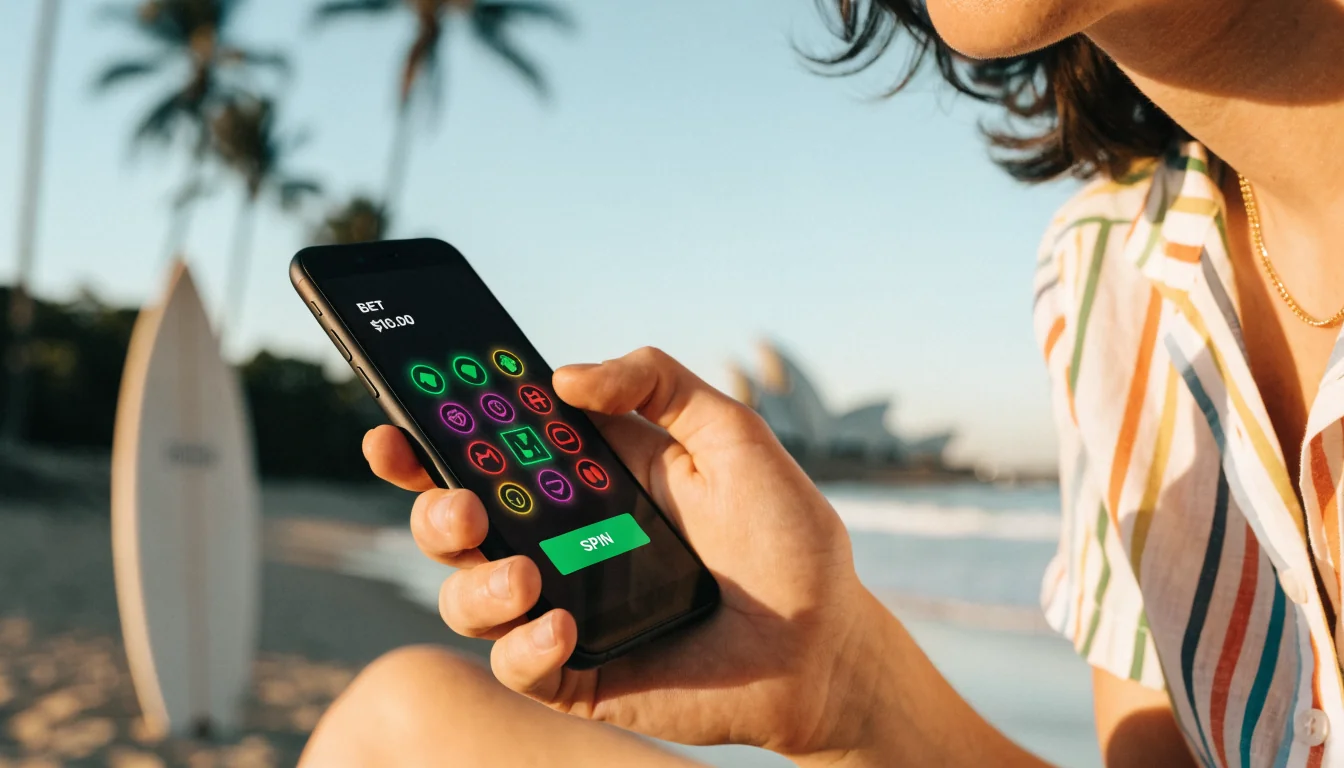
What stays consistent across both platforms is the account itself. Whether you’re on an Android phone, an iPhone, or later switch to a desktop, your login, balance and session carry over. Start a session on your phone during a commute, pick it up later on a laptop, and nothing resets. This continuity is one of the few things browser-based and native access have in common, and it’s arguably more useful than the app itself, since it means the platform choice comes down to convenience rather than which device holds your data.
The rest of this guide breaks down how that browser experience actually works, what iPhone users specifically need to know, and where Android’s native apps fit into the picture.
How Mobile Browsers Deliver Online Casino Experiences
A mobile web app is not a lighter version of a real casino platform. It is the platform. Almost every operator serving Australian players builds on HTML5, a web standard that runs directly inside Safari or Chrome without asking anyone to install anything from a store. The browser handles the graphics, the touch input and the session state, which is why this approach has become the default rather than a workaround.
What HTML5 actually does
HTML5 replaced the old Flash-based casino sites, which needed plugins that mobile browsers never supported well. The newer standard scales to whatever screen it’s opened on, responds to taps and swipes the way a native app would, and keeps registration, deposits, gameplay and withdrawals inside a single browser session. Nothing gets handed off to a separate app or a separate login. You open a link, you’re playing.
Speed matters more on mobile than desktop, since there’s no second monitor to switch to while something loads. On a standard 4G connection, most casino games open in well under five seconds. Slower loading usually points to a poorly optimised site rather than a network problem, since the format itself is built for exactly this kind of connection.
Slow loading can indicate a poorly optimised site rather than a network problem. If games take more than a few seconds to appear, you may experience a degraded experience on mobile.
Turning a browser tab into an app
The step that makes this feel less like a website and more like software is adding the page to the home screen. Both iOS and Android let you do this in a couple of taps: open the site, use the browser’s share or menu option, and choose to add it to the home screen. The result is an icon that behaves like any other app — it launches straight into the lobby, runs full-screen without browser address bars, and sits alongside your other apps rather than buried in browser bookmarks. No app store, no download, no waiting on a review process. It’s the same web app, just presented without the browser dressing.
Designing a lobby for a thumb, not a mouse
The interface choices that separate a well-built mobile casino from a clumsy one are mostly about where things sit on the screen. A lobby built for a phone should scroll vertically, with game tiles sized so a thumb can tap the right one without zooming in first. Horizontal carousels and desktop-style grids tend to cause mis-taps, which is a small annoyance that compounds over a session.
Two things should never require more than one tap to reach, regardless of where you are in the app:
- Search and filters — so you can narrow hundreds of titles down by provider or game type without backing out to a menu first.
- Cashier and account settings — reachable through a persistent top menu that stays visible as you scroll, rather than one that disappears once you leave the homepage.
That persistence matters more than it sounds. A menu that vanishes after the first scroll forces you to scroll back up every time you want to check a balance or make a deposit, which is a poor way to build something meant to be used one-handed on a train or a couch.
Session continuity is the other piece that’s easy to take for granted until it’s missing. Logging in on a phone should show the same balance, the same account details and the same game history as logging in on a desktop or tablet, because it’s the same account behind the same session — not a separate mobile-only profile with its own quirks.
None of this requires downloading an app in the conventional sense. It requires a browser, a stable connection, and a site built with mobile use as the default rather than an afterthought. The next section looks at what this means specifically for iPhone users, who have no alternative to this browser-based route at all.

Casino Access on iPhone: What You Need to Know
If you’re searching for iPhone casino apps in Australia’s App Store, you won’t find any. Apple blocks offshore gambling apps outright, and there is no legal path for a domestically licensed casino app to appear there either, since online casino games can’t be licensed in Australia at all. Native casino apps in this country exist only on Android. Every iPhone user is routed through the mobile browser instead — and that’s not the compromise it sounds like.
What actually works on Safari
A properly built HTML5 casino site loads directly in Safari or Chrome on iOS, responds to touch the same way a native app would, and scales correctly to whatever iPhone or iPad screen you’re using. Registration, deposits, gameplay and withdrawals all happen inside that same browser session — there’s no separate download step, no update to install, no App Store review standing between you and the lobby. The browser is the app.
This matters more on iPhone than on Android, because it’s the only option. If the site is slow to load, mistracks taps, or buries the cashier three menus deep, there’s no alternative native version to fall back on. Test it before you commit any money: open the lobby, try the filters, try search. Both should be reachable in a single tap from wherever you are on the page. If they’re not, that’s the site’s fault, not your phone’s.
Apple Pay is supported on many Australian casino sites and offers the fastest deposit method on iPhone because it uses the device’s built‑in biometric authentication.
Making it feel native
Adding the site to your Home Screen turns it into something close to a real app instantly. On iOS, this is done through Safari’s share menu — the icon lands on your Home Screen, opens without the browser address bar, and behaves like any other app icon when tapped. It doesn’t require a download, and it doesn’t touch the App Store’s rules, because nothing is being installed in the technical sense. It’s a shortcut, not software.
This is worth doing before you deposit anything, not after. A shortcut that fails to load properly, freezes on the cashier page, or loses your session partway through a game tells you what to expect before real money is involved.
Paying on an iPhone
Apple Pay is supported on mobile casino platforms as a deposit method, alongside Google Pay for Android users. On iPhone specifically, Apple Pay tends to be the fastest way to fund an account because it uses the authentication already built into the device — Face ID or a passcode — rather than requiring you to type card details into a mobile browser field. It’s worth checking whether a site supports it before assuming it does, since not every platform offers the same range of options.
What to check before you play
- Does the site load cleanly in Safari, or does it stall and require reloading?
- Can you reach filters and search in one tap, or are they buried?
- Does adding it to the Home Screen produce a working shortcut, or a broken one?
- Is Apple Pay listed as a deposit option, and does it actually complete a transaction in testing?
- Does the cashier stay accessible throughout a session, or does it require logging back in?
None of this requires spending money to verify. A few minutes in the browser, before any deposit, tells you whether the "web app" experience holds up on an iPhone specifically — screen size, touch response and session stability don’t always translate the same way from Android to iOS, even on the same site.
Top Android Casino Apps and Their Requirements
Choosing a casino app worth your time comes down to real payout speed, welcome value, and licensing you can verify, so here’s what stands out about each app on this list.
Bonus: up to A$7,500 + 550 free spins across 10 deposits, 50x wagering · Payout speed: crypto under 1 hour, PayID 1-3 business days · Min. deposit: A$20 (A$30 to qualify for the bonus) You get a sizeable welcome package spread across ten deposits, backed by fast crypto payouts under an hour and PayID withdrawals within a few business days.
License: Curacao Gaming Control Board OGL/2023/176/0095 (Hollycorn N.V.) · Bonus: up to A$11,000 + 300 free spins (code NEO100) Licensed under the Curacao Gaming Control Board via Hollycorn N.V., it pairs that oversight with a large deposit bonus and free spins unlocked through a bonus code.
Bonus: up to A$750 + 50 jackpot spins, 35x wagering · Payout speed: crypto ~90 minutes, fiat 1-5 days · Min. deposit: A$30 A jackpot-spin bonus with reasonable wagering terms is matched by quick crypto payouts of around 90 minutes and fiat withdrawals within a working week.
License: Curacao, operated by Dama N.V. · Bonus: 325% up to 5.25 BTC + 250 free spins across 4 deposits Operated by Dama N.V. under a Curacao license, this app offers a high-percentage bonus in Bitcoin terms spread across multiple deposits, appealing to crypto-first players.
License: Curacao Gaming Control Board · Bonus: up to A$5,000 + 400 free spins Licensed by the Curacao Gaming Control Board, it backs its credentials with a straightforward welcome package combining a cash bonus and free spins.
Bonus: 100% up to A$750 + 200 free spins, 35x wagering · Payout speed: crypto 30-120 minutes, fiat 24-72 hours · Min. deposit: A$30 Its welcome bonus comes with manageable wagering requirements, and you can expect quick crypto payouts within a couple of hours or fiat withdrawals within a few days.
License: Curacao Gaming Control Board OGL/2023/176/0095 (Hollycorn N.V.) · Bonus: 100% up to A$10,000 + 100 free spins Regulated under the same Curacao license umbrella as Hollycorn N.V., it stands out for a generous matched deposit bonus alongside a modest free spins package.
License: Curacao – Antillephone N.V. (Versus Odds B.V.) · Bonus: up to EUR 2,000 across 5 deposits + 200 free spins · Min. deposit: EUR 20 Licensed via Antillephone N.V. under Versus Odds B.V., it offers a multi-deposit bonus structure with free spins and a low minimum deposit to get started.
License: Curacao · Bonus: 100% up to A$500 + 200 free spins, 10x wagering · Payout speed: crypto 30-60 minutes, fiat 1-5 days · Min. deposit: A$10 With a low wagering requirement and a small minimum deposit, this Curacao-licensed app also delivers rapid crypto payouts within the hour.
License: Curacao OGL/2024/1335/0780 · Bonus: up to A$1,000 + 150 free spins, wager-free · Min. deposit: EUR 20 Its wager-free bonus is a notable draw, operating under a specific Curacao license number that you can look up directly.
Android is the only platform in Australia where a native casino app can legally exist outside the browser. Google Play permits gambling apps on its store, but only under strict conditions: the app must hold a valid gambling licence and carry an Adults Only (AO) age rating before it appears in search results for Australian accounts. Apps that skip this step simply don’t get listed — there’s no workaround, and no version of an unlicensed app should be trusted regardless of where it’s linked from.
Once installed through Google Play, these apps generally support the same deposit tools available in the mobile browser version, including Google Pay for quick top-ups alongside other standard payment methods. The core gameplay, account, and cashier functions mirror what’s available on desktop or through a browser session, since most of these apps are still built on the same underlying web technology rather than a fully separate codebase.
iPhone owners don’t have this option. Apple’s store policies block gambling apps of this kind outright, which means any casino experience on iOS has to run through a browser instead — a distinction covered in more detail elsewhere in this guide.
Runs as a standalone application, distributed through Google Play, requires a gambling licence and an Adults Only rating.
Works in any browser on Android or iOS, adds to home screen for app‑like launch, no store approval needed.
Only available as a mobile web app; no native app can be listed in the App Store.
Real‑Money Play on Australian Casino Apps
Playing where cash actually moves changes what matters. Graphics and lobby layout stop being the point; what matters is whether a deposit clears before you lose interest, whether a withdrawal lands without a support ticket, and whether the currency on screen matches the currency in your bank account. None of the offshore platforms Australians use are locally licensed — that’s a fact of the legal landscape, not a quality signal — so the practical test is the cashier itself, not the marketing around it.
Currency and the friction it avoids
Any platform worth using on a phone should price everything in Australian dollars from the first screen. This sounds obvious, but it’s not universal — some offshore operators default to USD or EUR and quietly convert at the point of deposit or withdrawal, adding a spread you don’t see until the balance lands short. Native AUD pricing removes that step entirely: what you deposit is what shows up in your balance, and what you cash out is what hits your account, with no conversion math to check against. On a small screen, that difference is easy to miss until it costs you, so it’s worth confirming the currency selector before entering any card or bank details.
Getting money in
PayID is the standout deposit method for Australian mobile play. It works directly from a banking app, settles instantly, and supports high transaction limits, which matters if you’re funding an account beyond a token amount. There’s no card number to type on a phone keyboard and no waiting period — you authorise the transfer in your own bank’s app and the balance updates immediately in the casino session.
Apple Pay and Google Pay sit alongside PayID as supported deposit methods on most mobile casino platforms. Both let you fund an account using the biometric authentication already built into the phone, which is faster than manually entering card details and doesn’t expose the card number to the casino’s own systems. Their role here is deposits specifically — neither is a withdrawal channel, so don’t expect money to return the way it went in.
Cryptocurrency deposits are also widely supported, and for players already holding crypto, this is often the most direct route in: no bank intermediary, no currency conversion step if the platform prices in crypto-equivalent balances. The more relevant detail is what happens on the way out.
Getting money out
Withdrawals are where a platform’s real character shows, and this is also where mobile support most often falls short — some cashiers work fine on desktop but strip features down on a phone browser. That’s worth testing before you commit real funds: full cashier functionality, deposits and withdrawals alike, should be available on mobile, not just a stripped-down deposit form with withdrawals pushed to "contact support."
Cryptocurrency withdrawals are the fastest category by a wide margin, typically clearing within 30 minutes to two hours. If speed of access to funds matters more than anything else, this is the payment rail that delivers on it consistently.
Withdrawal limitations
Many platforms offer full cashier functionality on desktop but strip down or hide withdrawal options on mobile browsers, which can leave you unable to cash out.
E-wallets are the next tier down in speed but arguably more convenient for players who don’t hold crypto. Services like MiFinity, Jeton, Skrill and MuchBetter are widely supported across Australian-facing platforms and are consistently among the fastest fiat payout options — faster, in practice, than card withdrawals, which are often accepted for deposits but rarely offered as a withdrawal method at all. If a platform only lets you deposit by card, ask before you fund the account how you’re actually meant to get money back out.
PayID again earns a mention here specifically because it works both ways in principle — though individual platforms vary in whether they offer it as a withdrawal rail or restrict it to deposits only. Check this before assuming symmetry between how money goes in and how it comes out.
What a bonus structure typically looks like
Bonus offers follow a recognisable shape across the market, though the exact numbers are set by each operator and vary between them — treat any specific figure as a snapshot from one offer, not a guaranteed baseline. A welcome package commonly takes the form of a percentage match on the first deposit paired with a batch of free spins; one operator’s current offer, for example, structures this as a 100% match up to a set ceiling plus a fixed number of free spins, but this is that operator’s own published term rather than an industry standard, and other platforms structure it differently.
Reload bonuses — offers tied to deposits made after the welcome package — generally require a minimum deposit to qualify, sitting in the tens of dollars range on the offers examined, though again this varies by operator and by promotion.
Cashback is the other recurring structure: a percentage of net losses returned on a weekly cycle, sometimes tiered so that higher account levels receive a larger percentage and a higher ceiling. Where this exists, it functions less like a bonus and more like a partial loss rebate, which makes it worth comparing against wagering-based offers rather than assuming it’s automatically better or worse.
Bonus structure overview
The typical welcome package includes a percentage match on the first deposit plus a set number of free spins. Reload bonuses usually require a minimum deposit of around A$30, and cashback is offered on a weekly basis with tiered percentages.
The wagering requirement is the real price tag
Every bonus carries a wagering requirement — a multiplier applied to the bonus amount (sometimes to the deposit plus bonus combined) that must be bet through before winnings can be withdrawn. Multipliers in the 35x to 45x range are common across the offers reviewed, and they apply on top of a time limit: the wagering typically needs to be completed within a window of roughly one to four weeks from when the bonus is credited, after which unused bonus funds and any winnings tied to them are usually forfeited.
The practical effect is that a bonus’s face value tells you almost nothing about what it’s actually worth to you. A match bonus with a low multiplier and a generous deadline is meaningfully different from one with a high multiplier and a tight window, even if the headline dollar amount is identical. Before opting into any offer, look specifically for:
- The multiplier — applied to bonus only, or to deposit plus bonus.
- The time window — how many days you have to clear it.
- Game weighting — whether slots count fully toward wagering while table games count at a reduced rate or not at all.
- Maximum bet size while a bonus is active — some terms void the bonus if a single bet exceeds a cap.
None of these terms are standardised across the market, and they change between operators and between promotions from the same operator over time. The only reliable approach is reading the specific terms attached to the specific offer in front of you before you deposit against it — not assuming it matches what a previous platform, or a previous promotion, offered.
Identity checks before withdrawal
Regardless of payment method, expect an identity verification step before the first withdrawal clears — government-issued ID, and sometimes proof of address, requested by the platform to comply with standard anti-fraud and age-verification practice. This is separate from the payment method itself and applies whether you’re cashing out via e-wallet, crypto, or bank transfer. Submitting these documents early, rather than waiting until a withdrawal is pending, avoids the most common source of payout delay.
Welcome Bonuses, Free Spins and No‑Deposit Offers
The sign-up offer is usually the first thing you see before you have even loaded a game, and it is worth reading past the headline number. One industry review of current promotions lists a typical welcome package as a 100% match up to A$750 plus 200 free spins — a figure the operator itself sets and can change at any time, so treat it as an example of the shape these offers take rather than a market standard.
Free spins attached to a welcome package almost always apply to a limited selection of slots, not the full catalogue, and any winnings they generate are added as bonus funds rather than paid out directly. No-deposit offers exist on some platforms as a smaller, no-risk way to sample the lobby before committing card or e-wallet details, but they carry the same wagering conditions as deposit-based bonuses and are usually capped at modest amounts.

Reload and Loyalty Promotions
Once the welcome offer is used, most platforms shift to reload bonuses to keep depositing players active. According to the same operator terms, reload bonuses commonly require a minimum deposit of around A$30 to qualify — again, an operator-set figure rather than a fixed rule across the market.
Cashback is the other recurring mechanic. One operator’s published terms describe weekly cashback of 10% up to A$750, rising to 25% up to A$4,500 at higher VIP tiers. These numbers illustrate how cashback scales with loyalty status rather than confirming what any specific site currently offers — check the terms page of whichever platform you use before assuming the same structure applies.
Reading the Wagering Requirements
The part players skip and later regret is the wagering requirement — the multiple of the bonus amount you must bet through before any winnings become withdrawable. Industry-wide, these multipliers commonly sit around 35x, though the exact figure and the calculation method (bonus only, or bonus plus deposit) vary by operator and by promotion.
Just as important is the expiry window. The same source that quotes 35x wagering also ties it to a completion deadline of 7 to 30 days. Miss that window, whether because the wagering was too steep for casual play or because the countdown started the moment the bonus was credited rather than when you first used it, and the bonus and anything attached to it is forfeited.
Wagering requirements
Every bonus carries a wagering multiplier (often 35‑45x) and a limited time window; failing to meet these conditions means the bonus and any attached winnings are forfeited.
Before opting in to any offer, look for these terms on the promotions page itself, not just in a pop-up banner. The rules a market’s advertising standards require operators to display up front should cover wagering multiples, minimum odds or bet sizes, eligible games, and expiry, all before you tap "claim." If any of that is missing or vague, treat the offer as unverified rather than assuming it matches whatever another operator advertises.
None of these figures — the match percentage, the reload minimum, the cashback tiers, the wagering multiple, the expiry window — are fixed across the industry. They come from individual operators’ current terms, which are revised often. Confirm the live version on the platform you’re actually using before it factors into any deposit decision.
Free Casino Apps and Zero‑Cost Features
Not every session needs a deposit. Most mobile browser casinos let you open the lobby, pick a game, and spin in demo mode without registering a payment method first — a way to test how a platform actually feels before any money changes hands.

The technical side of this matters more than it sounds. A well-built HTML5 casino loads directly in Safari or Chrome, responds properly to touch input, and scales to whatever screen you’re holding, whether that’s a phone or a tablet. On a 4G connection, most games load in under five seconds — slow enough that you’ll notice, fast enough that you won’t lose interest waiting.
What to check before you commit to a platform
Since you’re not spending anything, this is the right moment to judge the interface on its own terms. A few things separate a genuinely usable free-play lobby from one that just looks fine in a screenshot:
- Vertical scroll with tap-accurate tiles. The lobby should scroll smoothly on one hand, with game tiles sized so you land on the one you meant to touch, not the one next to it.
- One-tap filters and search. If you’re looking for a specific title or provider, the search bar and filter options should be reachable from wherever you are in the lobby — not buried three menus deep.
- Consistent behaviour in demo mode. The demo version should look and play like the real thing: same graphics, same pacing, same interface. If it feels stripped down, that’s a sign the whole platform was an afterthought on mobile.
None of this costs you anything to test. Load a game, play a few rounds in free mode, and pay attention to whether the tiles respond where you tap and whether menus stay put as you move around. A platform that struggles at this stage — sluggish tiles, filters that need a second tap, load times that drag — is unlikely to improve once real transactions are involved.
Why "free" is a testing tool, not just a feature
Free-play mode exists for a reason beyond letting you try a game for fun. It’s the only way to evaluate a browser casino’s engineering without registering or handing over card details. Because the RNG and game logic run the same way in demo as they do in paid mode, what you see — loading speed, touch response, layout — is a fair preview of the real thing, not a simplified version built to look good.
Free‑play mode only tests the front‑end experience; it does not reveal how deposits, withdrawals or support will behave once you fund an account.
The catch is that free play only shows you the front end. It won’t tell you how deposits, withdrawals or customer support behave, since those systems only activate once an account is funded. Treat the free version as a filter for interface quality, not as a full audit of the platform — that comes later, once you’re ready to move past testing.
iOS and iPad Optimised Casino Browsers
An iPad screen sits between a phone and a desktop monitor, and a well-built HTML5 casino has to answer for both. The same web app that runs on Safari on an iPhone loads on an iPad without a separate build, scales its layout to the larger canvas, and still responds to touch rather than a cursor. Registration, deposits, gameplay and withdrawals all happen inside that one browser session, regardless of which Apple device opened it.
What changes on a tablet is spacing, not structure. The lobby still uses vertical scroll, but the extra width means more tiles per row before you need to scroll further, and each tile stays tap-accurate rather than shrinking to fit more games onto the screen. That distinction matters on iPad more than on a phone, because the temptation for a poorly built site is to cram in extra columns and leave you tapping the edge of a slot instead of its centre.
Persistent navigation carries over from the phone experience. The cashier and account settings should sit behind a top menu that stays visible as you scroll through games, so switching from a slot to a deposit screen doesn’t mean hunting for a hidden button or reloading the page. On an iPad’s larger display, that top menu typically has room to show a few more labels at once — deposits, promotions, support — without collapsing into a single icon the way it might on a phone.
What to check before relying on an iPad browser
- Orientation handling. Rotate the iPad and see whether the lobby reflows cleanly or whether tiles overlap the menu.
- Load behaviour on the same session. Move from lobby to a game to the cashier and back, confirming the session and balance stay consistent throughout — no re-login, no dropped state.
- Touch accuracy at scale. Larger screens can create larger tap targets, but also more dead space; confirm the tiles you tap are the tiles that open.
- Menu persistence during scroll. A top menu that disappears once you start scrolling defeats the point of having one.
None of this requires installing anything. Safari and Chrome on iPadOS run the same HTML5 casino that a phone uses, and Apple’s restriction on native casino apps applies equally to the iPad — there is no separate App Store workaround for the larger device. The practical test is the same one worth running on a phone: open the site, scroll the lobby, tap a few tiles, and check the cashier before putting any money through it. An iPad’s bigger screen makes sloppy scaling more obvious, which, if anything, makes it a better device for spotting a poorly adapted casino than a phone is.
Payment Options that Actually Pay Out
Not every payment method advertised on a casino’s homepage actually gets tested at the withdrawal stage. Some are deposit-only, some carry hidden delays, and a few simply don’t work the way the site claims. What matters is what happens when you try to move money out, not in.
PayID reliability
PayID provides instant, high‑limit deposits directly from a banking app and works consistently across both Android and iOS browsers.
PayID is the most consistent option available to Australian players. It works directly from a mobile device, deposits go through instantly, and it supports high limits without the friction of manual bank details. Because it’s tied to your phone number or email rather than a card number, there’s less to get wrong when you’re entering details on a small screen mid-session.
Apple Pay and Google Pay are also supported across most mobile casino platforms, but treat them as deposit tools rather than a full payment solution. They speed up funding an account, but withdrawals typically don’t route back through the same channel — you’ll usually need a separate method for cashing out.
Cryptocurrency sits at the other end of the spectrum: it handles both directions well. Deposits are supported broadly, and withdrawals are processed within 30 minutes to 2 hours, which is faster than most fiat alternatives. The trade-off is the extra step of holding or converting crypto in the first place, which isn’t for everyone.
What to check before you rely on a method
- Deposit-only methods — Apple Pay and Google Pay fall here; useful for funding, not for getting paid.
- Instant, high-limit methods — PayID covers this on the deposit side.
- Fast payout methods — crypto withdrawals clear within hours rather than days.
Before committing to a platform, test the cashier with a small deposit and see which withdrawal options actually appear afterwards — the list offered at deposit time doesn’t always match what’s available when you try to take money out. A method that processes instantly going in but stalls going out isn’t a payment option, it’s a one-way door. The safest approach is to confirm withdrawal speed and limits directly in the cashier before treating any method as your primary one.
Gambling Regulations and Fair Play in Australia
Australian law treats online casino games as a separate matter from sports betting. The Interactive Gambling Act 2001 prohibits any operator from offering online casino games, poker, or in-play betting to residents, and no domestic licence exists for this kind of product. That restriction falls on operators, not players — there’s no penalty for an Australian who plays through an offshore site. But it also means there’s no local regulator to appeal to, no public register to check an operator against, and no domestic body enforcing fair-play standards on the platforms people actually use. Anyone recommending you "check the licence" on a public register is describing a system that doesn’t exist here; what you can check is which offshore jurisdiction issued the licence and what that licence actually covers.
Fairness at the game level works differently from fairness at the regulatory level. The random number generator that decides slot and table outcomes runs server-side, not on the phone or tablet in your hand. That means the device you’re playing on — a five-year-old Android phone or a current iPhone — has no influence on results. The outcome is generated and verified on the operator’s infrastructure before it ever reaches your screen.

Live-dealer tables are a different case, because they stream video in real time rather than generating outcomes locally. Performance depends on connection quality more than on hardware. A stable Wi‑Fi connection handles the video feed and betting window more reliably than 4G, where fluctuating signal strength can cause the stream to lag behind the actual game state. If you’re testing a live table before committing, do it on Wi‑Fi first, and treat a mobile-data session as a fallback rather than the default.
Can I win real money on mobile casino apps in Australia?
Yes, you can. The mobile platforms serving Australian players handle real-money deposits, gameplay and withdrawals entirely within your browser session.
What are the best online casinos in Australia for 2026?
You won’t find them as native app store downloads. The leading platforms are HTML5 web apps you open in a mobile browser, offering instant access, full lobbies, and continuous sessions across your devices.
What are the top welcome bonuses for Australian players in 2026?
A typical welcome bonus is 100% up to A$750 plus 200 free spins. You’ll usually need to meet wagering requirements of 35x to 45x the bonus amount within 7 to 30 days.
Is there a real money casino Australia app?
Yes, but only on Android. iPhone users must use a mobile browser since Apple’s store policies block real-money casino apps entirely.
Is it legal to play at mobile casinos in Australia?
Offshore operators serve Australian players through browser-based web apps rather than native store listings, bypassing local rules and platform policies that make app distribution narrow.
What payment methods are available for Australian players at online casinos?
You can use PayID, Apple Pay and Google Pay for deposits, along with crypto and e-wallets like MiFinity, Skrill and MuchBetter. E-wallet and crypto withdrawals are fastest, while cards are deposit-only.
Published by the Casino Jackpots Guide team.